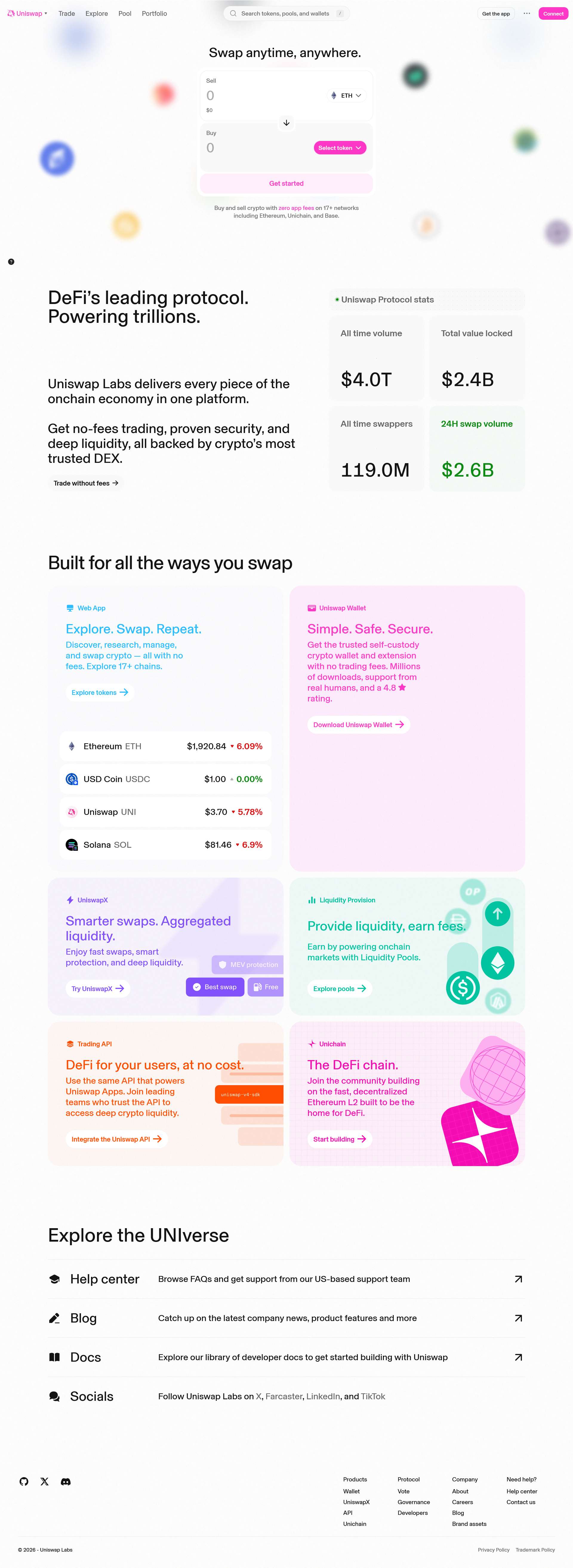
Uniswap is one of the foundational applications in decentralized finance (DeFi). Built on the Ethereum, it introduced a radically different way of trading crypto assets—without order books, centralized intermediaries, or traditional market makers.
Instead of matching buyers and sellers directly like a conventional exchange, Uniswap uses an automated system called an automated market maker (AMM). This model has reshaped how liquidity is provided and how tokens are traded across DeFi ecosystems.
How Uniswap Works ://
At the core of Uniswap is the idea of liquidity pools. These pools are smart contracts containing pairs of tokens (for example, ETH/USDC). Users called liquidity providers (LPs) deposit equal-value amounts of both tokens into a pool.
When someone trades on Uniswap, they are not trading against another user. Instead, they are trading against the liquidity pool itself. Prices are determined by a mathematical formula, most commonly:
This mechanism ensures that every trade shifts the price slightly based on supply and demand.
Key Features of Uniswap ://
1. Permissionless Trading :/
Anyone can list a token or create a liquidity pool without approval. This open-access model has led to massive token diversity, but also increased exposure to riskier or lower-quality assets.
2. Automated Market Making :/
Unlike traditional exchanges that rely on order books, Uniswap uses algorithms to price assets. This removes the need for professional market makers.
3. Liquidity Provision and Fees :/
Liquidity providers earn a portion of trading fees (typically 0.05%–0.3% depending on the pool version). This incentivizes users to supply liquidity, which is essential for the system to function.
4. Non-Custodial Design :/
Users retain control of their funds at all times through their wallets. Trades are executed via smart contracts, reducing reliance on centralized exchanges.
Evolution of Uniswap
Uniswap v1
The original version introduced AMMs on Ethereum, but only supported trading between ETH and ERC-20 tokens.
Uniswap v2
Expanded functionality by allowing direct ERC-20 to ERC-20 swaps, improving efficiency and flexibility.
Uniswap v3
A major upgrade that introduced concentrated liquidity, allowing LPs to allocate funds within specific price ranges. This dramatically improved capital efficiency but also increased complexity for liquidity providers.
Role in the DeFi Ecosystem
Uniswap has become a cornerstone of DeFi infrastructure. It is widely used for:
1. Token launches and initial liquidity 2. Arbitrage trading across exchanges
3. Price discovery for new assets 4. Integration with wallets and DeFi aggregators
// Because it is open-source and decentralized, many other protocols have forked or built upon its design.
Advantages and Limitations ://
Advantages :/
1. Fully decentralized trading 2. No account creation or KYC required
3. High liquidity for major token pairs 4. Composable with other DeFi protocols
Limitations :/
1. Exposure to impermanent loss for liquidity providers
2. Vulnerability to volatile or low-quality tokens
3. Gas fees on Ethereum can be high during network congestion
4. Complex mechanics for newer users (especially in v3)
Risks and Considerations
While Uniswap is powerful, it is not risk-free. Users should be aware of:
1. Smart contract risk (bugs or exploits)
2. Impermanent loss in volatile markets
3. Front-running and MEV (maximal extractable value) attacks
4. Scam tokens listed without permission
// Proper research and risk management are essential when interacting with DeFi protocols like Uniswap.
The Future of Uniswap
Uniswap continues to evolve alongside Ethereum scaling solutions such as rollups. Future developments are likely to focus on:
1. Lower transaction costs through Layer 2 adoption
2. Improved capital efficiency
3. Better user experience for non-technical users
4. Cross-chain liquidity expansion
// As DeFi matures, Uniswap remains one of the most important experiments in decentralized market design.

Offline Website Builder